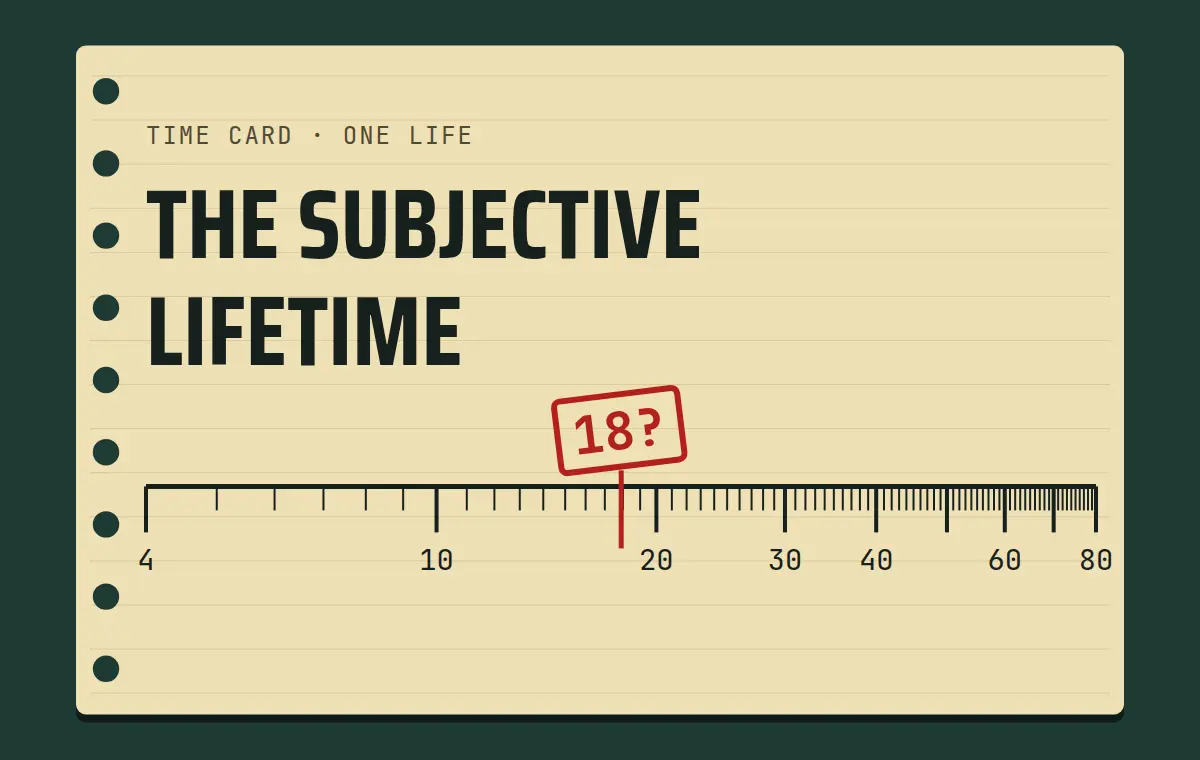
Half a lifetime by 18?
A proposition about human temporal perception suggests that approximately half of a person's subjective lifetime has already elapsed by age 18.
Not half of their chronological lifespan.
Half of their experienced lifespan.
The distinction arises because time does not necessarily feel as though it passes at a constant rate throughout life.
A year at age five occupies a different place in personal experience than a year at age fifty.
Childhood feels expansive. Adulthood can feel increasingly compressed. Decades begin to pass as though they were years.
Research documents a tendency for people to report that longer periods of time pass faster as they age.
But the specific claim that age 18 represents the subjective midpoint is not an established scientific measurement.
The dial: find your own midpoint
If a year feels proportional to the life already lived, the middle of a life sits at the square root of its first remembered age times its last. Move the ends.
17.9is the midpoint on these settings.
A model from 1877, not a measurement of you. Nothing you set here leaves this page.
Our starting question is therefore not whether 18 is the correct number. It is what produces the apparent acceleration of experienced time.
And whether that acceleration is inevitable.
Age or experience?
The conventional explanation associates subjective acceleration with chronological aging.
But aging is only one variable.
Consider what happens when a person encounters something genuinely unfamiliar.
- A new language.
- A new country.
- An unfamiliar culture.
- A different social environment.
- A new occupation.
- The arrival of a child later in adulthood.
- A fundamental revision of previously held beliefs.
These experiences demand more than the repetition of established knowledge.
They require new observations, new relationships, new memories, and sometimes an entirely different understanding of reality.
The person is not simply adding information.
They are reconstructing the framework through which information becomes meaningful.
This raises the possibility that subjective time is shaped partly by the frequency and intensity of cognitive reconstruction.
A person who continues rebuilding their understanding at age 50 or 70 does not necessarily follow the same experiential trajectory as someone whose environment and expectations have remained stable for decades.
That does not establish that novelty prevents subjective acceleration.
It establishes a variable worth investigating.
Routine and memory compression
Repetition changes how experiences are encoded and remembered.
When days follow similar patterns, fewer distinctive events separate one period from another in retrospective memory.
A year filled with repetitive experiences can become difficult to distinguish from the preceding year.
By contrast, a period containing major transitions can acquire numerous autobiographical landmarks.
The punch card: mark the years something changed
A move, a language, a new line of work, a child, a belief you gave up. Tap a year to punch it. Tap again to clear it.
An unpunched run of years has nothing in it to tell one from the next.
This draws the question, with each punch counted as one extra year of landmarks. It measures nothing, and nothing leaves this page.
The distinction is particularly important because experiencing time and remembering time are not identical processes.
An unfamiliar activity can make time feel short while attention is fully occupied.
Yet the same period can feel comparatively rich and extended when remembered afterward.
This suggests that subjective temporal acceleration cannot be explained by one simple mechanism.
Attention, memory, novelty, emotional significance, and retrospective reconstruction all matter.
Research by Avni-Babad and Ritov examined the relationship between routine and remembered duration.
Wittmann and Lehnhoff documented age-related differences in the reported passage of time, while finding that chronological age explained only a limited portion of the variation.
The implication for our inquiry is straightforward.
Aging and experiential repetition must not be treated as interchangeable explanations.
The formative years
Now introduce schooling.
Children enter formal education during the period in which they are developing their understanding of authority, autonomy, time, and social relationships.
Schooling introduces institutional routines:
- Attendance.
- Timetables.
- Assigned locations.
- Permission structures.
- Standardized tasks.
- Deadlines.
- Evaluation.
- Compliance.
- Progression through grades.
These arrangements do more than organize the delivery of academic subjects.
They establish a practical relationship between the individual and an institution that controls substantial portions of their time.
The child learns not only what to study but when to study, how long to study, what constitutes acceptable performance, and who has authority to decide.
This is part of what educational researchers call the hidden curriculum.
The Hidden CurriculumThe syllabus that dismantles itself: why the tools for reading the institution are kept inside the institution.The question is whether schooling also conditions the relationship between routine, autonomy, and the experience of time.
Not every routine is imposed.
Not every school uses the same pedagogy.
But compulsory institutional routines deserve examination because they occupy such a substantial portion of formative life.
The School DayWho holds the clock, who carries the load: five schooling arrangements across 13 Canadian jurisdictions.Schooling and the organization of adult work
The next relationship is between the organization of school and the organization of employment.
Both can rely on:
- Externally determined schedules.
- Assigned responsibilities.
- Hierarchical supervision.
- Performance measurement.
- Institutional rewards and sanctions.
- Standardized expectations.
The resemblance has been examined in the sociology of education.
Bowles and Gintis described a correspondence between social relationships in schooling and capitalist workplaces.
Philip Jackson examined the hidden curriculum of classroom life.
Ivan Illich questioned the institutional monopoly over legitimate learning.
These perspectives do not establish that every school was consciously designed to manufacture obedient workers.
They do establish that schooling has social functions beyond the transmission of knowledge.
Our inquiry asks whether the organization of time is one of those functions.
Does the child learn to organize life independently, or primarily to organize life around the requirements of an institution?
Routine is not the same as learning
An important distinction emerges.
A demanding routine can support intellectual development.
Learning a musical instrument, studying mathematics, practicing a language, or working through difficult philosophical texts can require sustained repetition.
But repetition serving self-directed inquiry is different from repetition serving institutional compliance.
The relevant variables include:
- Who establishes the objective?
- Who determines the method?
- Can assumptions be challenged?
- Can the activity change direction?
- Does repetition produce new understanding?
- Can the learner revise the framework itself?
A person can follow a demanding daily schedule while continually reconstructing their knowledge.
Another person can follow an equally demanding schedule while repeating established procedures without substantial conceptual change.
The timetable alone does not tell us what is happening cognitively.
This distinction matters when examining temporal perception.
The possible mechanism is not routine by itself.
It is the relationship among repetition, predictability, meaningful novelty, and cognitive reconstruction.
The adult who continues to change
Consider the person who repeatedly moves between countries, learns unfamiliar languages, encounters different cultures, changes occupations, or becomes a parent later in life.
Each transition can disrupt established expectations.
Previously useful assumptions stop working.
Social relationships must be rebuilt.
New responsibilities emerge.
The individual develops new mental models.
This produces an alternative to the assumption that adulthood necessarily becomes progressively more repetitive.
It also challenges the idea that formative experiences belong exclusively to childhood and adolescence.
Formative experience can continue throughout life.
The unresolved empirical question is whether sustained cognitive reconstruction changes the rate at which a person experiences or retrospectively remembers the passage of years.
The answer requires more than comparing chronological ages.
It requires examining lived environments, learning histories, major transitions, and autobiographical memory.
The distribution of experiential opportunity
Now the inquiry acquires an economic and institutional dimension.
Not everyone has equal opportunities to change their environment.
- Housing costs can constrain mobility.
- Employment schedules can limit discretionary time.
- Financial obligations can restrict experimentation.
- Administrative requirements can make transitions difficult.
Caregiving responsibilities can limit flexibility, even while introducing profound new experiences.
Access to education, transportation, social networks, and cultural environments also matters.
The ability to pursue new experiences is therefore partly shaped by material conditions.
But novelty should not be confused with consumption, tourism, or wealth.
People can reconstruct their understanding through community participation, mutual aid, caregiving, study, relationships, and self-directed inquiry.
The question is not who can afford the most experiences.
It is who has practical agency to change the conditions of their experience.
From routine to behavioural prediction
This introduces a different relationship.
Predictive systems identify patterns in observed behaviour.
Stable routines generate recurring observations.
Recurring observations can make some future actions easier to estimate.
A person who travels the same route, works the same schedule, makes similar purchases, and interacts with a relatively stable network produces recognizable behavioural patterns.
A person who changes environments and revises established assumptions introduces additional variability.
Neither person is entirely predictable or unpredictable.
But behavioural continuity is useful to prediction.
This raises a systems question:
What happens when institutions that organize repetitive behaviour are connected to technologies that measure and predict it?
This is not yet a claim of coordination.
It is an inquiry into the compatibility of institutional structures and predictive technologies.
LifeLog enters the equation
DARPA's LifeLog project, announced in 2003, proposed collecting and organizing extensive information about individual experiences and activities.
The concept included the development of computational representations of personal life histories.
Such records could support the identification of relationships, patterns, and recurring behaviour.
LifeLog introduces a new dimension into the inquiry.
Earlier, we examined routine from the perspective of the individual experiencing it.
Now we examine routine from the perspective of an external system observing it.
What is repetitive to the individual can be statistically useful to the observer.
A person's daily movements, interactions, purchases, communications, and institutional activities can become inputs into behavioural models.
The existence of LifeLog does not establish that schooling, employment, or urban planning were designed to support that project.
The relationship worth investigating is architectural.
What happens when systems for organizing human activity and systems for predicting human activity become connected?
LifeLogThe full file on the program, from its solicitation to the day it died, with Pattern of Life and The Closed Loop.Prediction and feedback
Prediction becomes more consequential when the institution making or using the prediction can influence the environment.
Consider an educational classification.
A student is assessed as unlikely to succeed in an advanced programme.
The assessment affects access to instruction, resources, and opportunities.
The student subsequently performs poorly.
That outcome becomes additional evidence supporting the initial classification.
But the classification itself influenced the conditions producing the outcome.
The same feedback mechanism can arise in employment, housing, credit, policing, and public administration.
The analytical distinction is between:
- Prediction Estimating an outcome.
- Intervention Changing the conditions under which the outcome occurs.
- Feedback Treating the resulting observations as new evidence.
A system that both predicts and intervenes can become involved in producing the patterns it subsequently measures.
This creates the possibility of self-reinforcing classifications.
The concern is not simply whether predictions are accurate.
It is how institutional decisions affect the opportunities available to contradict them.
The built environment
Urban planning enters the inquiry as one possible influence on behaviour.
The physical organization of a city affects daily activity.
The location of housing, schools, employment, transportation, shops, parks, and public services influences how people move and interact.
These arrangements can expand or restrict opportunities.
A neighbourhood with accessible services can reduce travel burdens and increase discretionary time.
A neighbourhood lacking essential services can create dependency on distant infrastructure.
Digital administration introduces another set of variables.
- Cameras.
- Automated enforcement.
- Movement records.
- Access permissions.
- Transportation data.
- Administrative classifications.
These technologies can operate independently of any particular urban-planning philosophy.
The 15-minute-city debate is one example of public concern about the relationship between physical infrastructure and administrative control.
But it is not the central subject of this inquiry.
Nor does the presence of such infrastructure establish a single coordinated behavioural programme.
The question is how built environments, digital systems, and institutional decisions interact to shape practical agency.
Whether a particular arrangement expands or restricts agency must be examined in its actual implementation.
The classification of human possibility
Predictive systems generally work from existing observations.
Human beings, however, can change the assumptions, relationships, environments, and goals that produced those observations.
A person's past behaviour is not a complete description of their future possibilities.
This becomes consequential when institutions use historical data to make decisions about access to resources.
An individual classified according to previous circumstances can encounter barriers to entering different circumstances.
The prediction can then participate in preserving the conditions it describes.
The underlying problem is a feedback relationship between classification and opportunity.
It raises questions about how institutions account for human change.
- Can classifications be revised?
- Can individuals challenge assumptions?
- Can new evidence replace old assessments?
- Can people enter unfamiliar roles?
- Can institutions recognize fundamental transformations rather than merely incremental variations?
These questions concern agency rather than prediction alone.
Returning to subjective time
We can now return to the original premise.
Why does time appear to accelerate as people age?
Several mechanisms deserve consideration:
| Mechanism | What it says | On file |
|---|---|---|
| Biological and cognitive aging | Changes in attention, memory, and information processing. | Plausible |
| Proportional experience | A year represents a declining fraction of chronological life. | Model only |
| Memory differentiation | Repeated experiences can become less distinct in retrospective memory. | Measured, for tasks |
| Novelty | Unfamiliar experiences create new demands on attention and memory. | Plausible |
| Cognitive reconstruction | Changes in foundational understanding can reorganize autobiographical experience. | Open |
| Institutional routine | Schools, workplaces, and administrative systems organize substantial portions of daily life. | Open |
| Material constraints | Economic and social conditions influence opportunities for change. | Open |
| Predictive feedback | Institutional classifications can influence which future experiences remain accessible. | Plausible |
These variables do not yet constitute a demonstrated single causal system.
They form a research framework.
Some relationships are well established.
Others are plausible.
Some remain speculative and require direct empirical investigation.
The task is to understand their interactions without assuming the answer in advance.
The open questions
The inquiry now contains several distinct questions.
- Is there a measurable subjective midpoint of human life, and does it vary substantially between individuals?
- How much of reported temporal acceleration is explained by aging, and how much by changes in experience and memory?
- Does sustained novelty or cognitive reconstruction alter the retrospective experience of decades?
- How do compulsory educational routines shape lifelong relationships to time, learning, and authority?
- Do educational institutions distribute opportunities for autonomy differently across socioeconomic classes?
- How do employment, housing, and administrative structures influence opportunities for continued formative experience?
- Does behavioural regularity make individuals more predictable to computational systems?
- Under what conditions do predictive classifications begin influencing the behaviour they claim to forecast?
- How do urban infrastructure and digital administration expand or restrict opportunities for self-directed change?
- Can these relationships be studied together without confusing correlation, institutional compatibility, and deliberate coordination?
Where the inquiry stands
We began with a number.
Eighteen.
A proposed midpoint of subjective human experience.
We questioned whether that midpoint reflects an unavoidable consequence of aging or a particular pattern of living.
That led to the role of novelty, learning, memory, and cognitive reconstruction.
Then to the organization of formative education.
Then to the relationship between schooling and employment.
Then to class differences in autonomy and authority.
Then to the institutional production of behavioural regularity.
Then to LifeLog and computational prediction.
Then to feedback between prediction and access to opportunity.
And finally to the environments, physical and digital, within which human beings live.
Each connection opens a new question.
None requires us to assume that all the systems were designed together.
None requires us to assume that they operate independently.
The object of inquiry is the relationship between experienced time, cognitive change, institutional routine, social hierarchy, and predictive power.
We have not established a universal subjective midpoint.
We have not established a unified programme connecting all these institutions.
We have identified a set of mechanisms and relationships worth investigating.
The central question remains open:
Is the acceleration of experienced time primarily something that happens to us as we age, or is it also something shaped by the way our lives are organized?
And if the organization of life matters, how much of that organization is chosen by the individual, and how much is determined by institutions?
Research foundations
- Janet, P. (1877). Une illusion d'optique interne. Revue philosophique, 3. Record
- Avni-Babad, D., and Ritov, I. (2003). Routine and the Perception of Time. Journal of Experimental Psychology: General, 132(4), 543–550. DOI
- Wittmann, M., and Lehnhoff, S. (2005). Age Effects in Perception of Time. Psychological Reports, 97(3), 921–935. DOI
- Friedman, W. J., and Janssen, S. M. J. (2010). Aging and the speed of time. Acta Psychologica, 134(2), 130–141. PubMed
- Berntsen, D., and Rubin, D. C. (2004). Cultural Life Scripts Structure Recall from Autobiographical Memory. Memory & Cognition, 32, 427–442. DOI
- Anyon, J. (1980). Social Class and the Hidden Curriculum of Work. Journal of Education, 162(1), 67–92. DOI
- Jackson, P. W. (1968). Life in Classrooms.
- Bowles, S., and Gintis, H. (1976). Schooling in Capitalist America.
- Illich, I. (1971). Deschooling Society.
- Foucault, M. (1975). Discipline and Punish.
- DARPA LifeLog programme documentation (2003–2004). The LifeLog file
A Feline Union publication. felineunion.org ·